Michelle Gardner
My Blog
Recovery
Why Moments of Courage Matter More Than Motivation
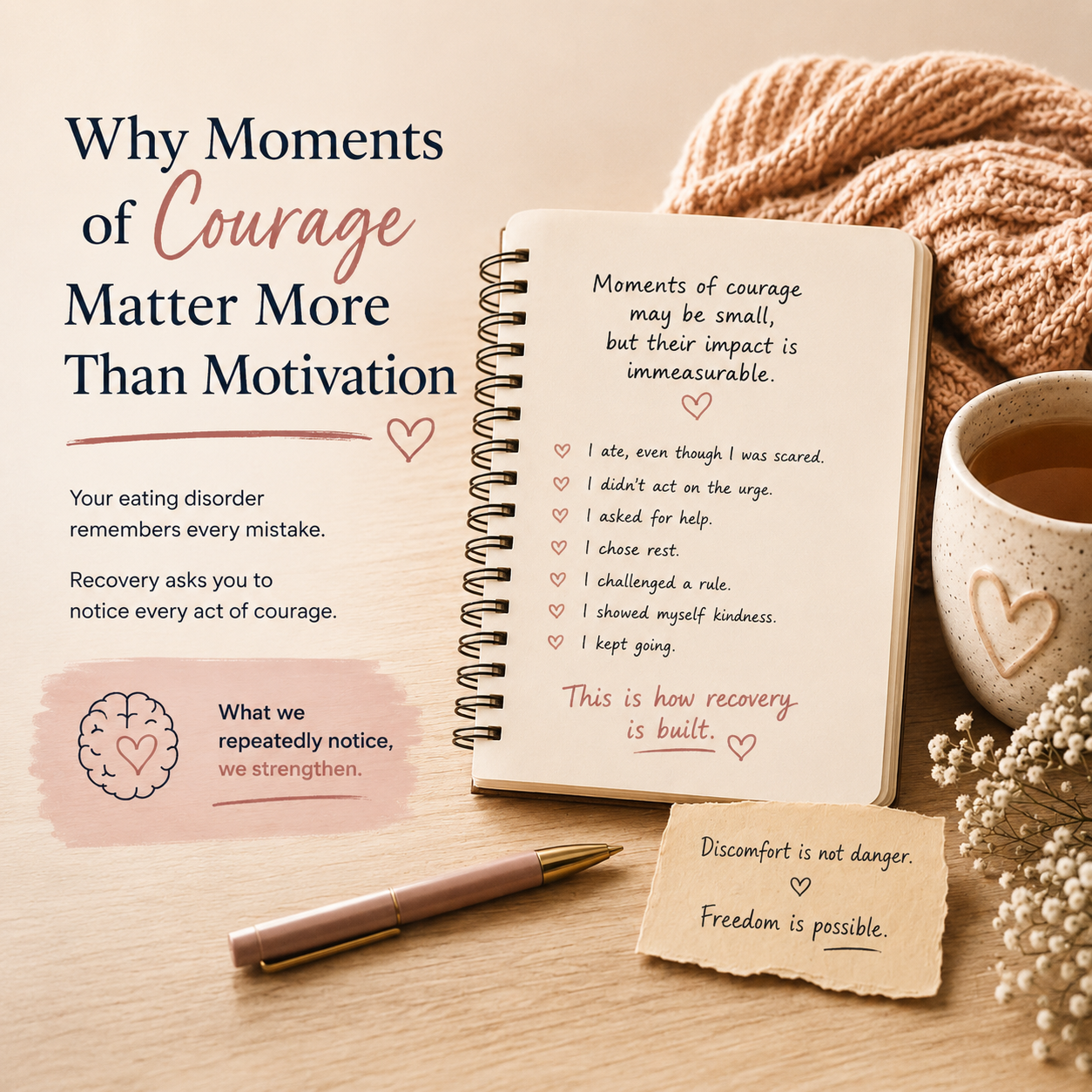
One of the things I notice over and over again when working with people recovering from eating disorders is this:
They become experts at remembering everything they believe they did "wrong."
They remember:
The binge
The skipped snack.
The biscuit.
The pizza.
The dessert.
The larger breakfast.
The meal out.
The body checking.
The exercise they didn't do.
The urge they acted on.
The moment they felt out of control.
Yet when I ask them what they did courageously that day...
They're often silent.
Not because courage wasn't there.
But because the eating disorder never taught them to look for it.
In fact, the eating disorder is an unreliable historian.
It keeps meticulous records of every perceived mistake, every uncomfortable feeling and every moment that seemed less than perfect.
But it conveniently forgets to record your courage.
It overlooks the meal you ate despite fear.
The urge you sat with instead of acting on.
The support you reached out for.
The rule you challenged.
The compassionate choice you made.
Recovery isn't about pretending the difficult moments didn't happen.
It's about creating a more honest record ofyour day.
One that includes not only your struggles, but also your courage.
Why This Matters
Our brains are constantly asking one question:
"What should I pay attention to?"
Whatever we repeatedly notice becomes the story our brain believes.
If every evening you mentally replay everything you think you did wrong, your brain strengthens those neural pathways.
Over time, it becomes quicker at spotting mistakes, threats and reasons to stay stuck.
Eventually, it can feel as though you're making no progress at all, even when you're working incredibly hard.
But here's the encouraging part.
Your brain also changes according to what you intentionally notice.
When you begin recognising moments of courage,your brain starts collecting different evidence.
Evidence that:
You can tolerate discomfort.
You can survive difficult emotions.
You are capable of doing hard things.
You don't have to obey every eating disorder thought.
Recovery is already happening, one choice at a time.
This isn't toxic positivity.
It's neuroscience.
You're deliberately teaching your brain tonotice a fuller, more accurate picture of your recovery.
What Is a Moment of Courage?
A moment of courage isn't feeling motivated.
It isn't feeling confident.
It isn't loving recovery.
A moment of courage is simply choosing to move towards the life you want while fear is still present.
It might look like:
Eating when every part of you wanted to restrict.
Stopping when your body had had enough, despite the urge to keep eating.
Sitting with the urge to binge, purge or compensate without immediately acting on it.
Allowing yourself to rest instead of exercising compulsively.
Finishing your meal despite anxiety.
Eating a food your eating disorder labelled "off limits."
Leaving food on your plate because you recognised comfortable fullness.
Going out with friends instead of isolating.
Wearing clothes that feel comfortable instead of trying to hide your body.
Resisting the urge to body check or weigh yourself.
Asking for help.
Beginning again after a difficult day.
None of these moments may feel extraordinary.
But they are.
Because every courageous choice is helping to weaken the eating disorder and strengthen the healthier part of your brain.
PracticalTool #1: Build Your Evidence File
At the end of each day, ask yourself one simple question:
"What was one moment of courage I had today?"
Write it down.
One sentence is enough.
Over time, you'll build what I like to call your Evidence File.
A collection of proof that your eating disorder isn't telling the whole story.
On the difficult days, go back and read it.
Not because recovery suddenly becomes easy.
But because it reminds you that you've faced fear before.
And you've survived it.
PracticalTool #2: Ask Yourself One Powerful Question
When recovery feels overwhelming, we often ask ourselves impossible questions.
"Can I recover?"
"Will this ever get easier?"
"What if I can't do this?"
Instead, ask yourself something much smaller:
"What is the next courageous choice?"
Not the next perfect choice.
Not the choice that feels comfortable.
Simply the next courageous one.
Maybe it's:
Eating the next meal.
Closing the calorie-tracking app.
Putting the scales away.
Waiting ten minutes before acting on an urge.
Texting your support person.
Leaving the kitchen after eating.
Choosing self-compassion over self-criticism.
Recovery is rarely built through giant breakthroughs.
It's built through hundreds of small courageous decisions that slowly become your new normal.
A DifferentWay to Measure Progress
Many people measure recovery by asking:
"Did I have eating disorder thoughts today?"
Or...
"Did I get everything perfect today?"
But those questions keep your attention focused on the eating disorder.
Instead, try measuring your recovery differently.
Ask yourself:
Did I respond differently today?
Did I stay with discomfort a little longer?
Did I challenge one eating disorder rule?
Did I show myself compassion instead of criticism?
Did I make even one decision that moved me towards the life I want?
Those questions tell you far more about your recovery than whether fear showed up.
Because fear will show up.
The real question isn't whether the eating disorder spoke today.
The real question is:
Who made the decision?
Was it the eating disorder?
Or was it your healthy self?
Every time you make the decision, even when it feels incredibly difficult, you strengthen the part of your brain that is learning freedom.
YourFive-Minute Courage Reflection
Before you go to bed tonight, spend just five minutes answering these four questions.
1. What was one moment of courage today?
Remember, courage doesn't have to be huge.
It simply means you did something your eating disorder didn't want you to do.
2. What did my eating disorder want me to do instead?
Naming the urge helps you recognise that it was an eating disorder message not a fact and not something you had to obey.
3. What did I choose to do?
Even if your response wasn't perfect, did you pause?
Delay the behaviour?
Ask for support?
Challenge one rule?
Show yourself kindness?
Every step matters.
4. What does this tell me about the person I'm becoming?
Maybe you're becoming someone who:
keeps promises to themselves.
can tolerate discomfort.
values health over fear.
asks for support.
chooses flexibility over rigid rules.
keeps going after difficult days.
trusts themselves a little more than they did yesterday.
This final question is perhaps the most important.
Recovery isn't simply about changing behaviours.
It's about becoming someone whose life is no longer dictated by fear.
Each night you complete this reflection,you're teaching your brain something incredibly powerful.
You're teaching it to become a more reliable historian.
One that remembers not only the difficult moments, but also the courage that existed alongside them.
Because what we repeatedly notice, we strengthen.
Final Thoughts
Recovery isn't built on waiting to feel motivated.
Motivation comes and goes.
Recovery is built through repeated moments of courage.
Every meal.
Every urge you sit with.
Every compassionate decision.
Every time you begin again after a difficult moment.
Every one of these choices is teaching your brain something new.
Perhaps the most important lesson of all is this:
Discomfort is not danger.
The more often you experience discomfort without allowing the eating disorder to make the decision for you, the more your brain learns that you are safe.
And one day, you'll look back and realise something extraordinary.
It wasn't one huge act of bravery that changed your life.
It was hundreds of quiet moments of courage that slowly rewrote your story.
Because recovery isn't built through motivation.
It's built through the courageous choices you make, especially on the days you least feel like making them.
